
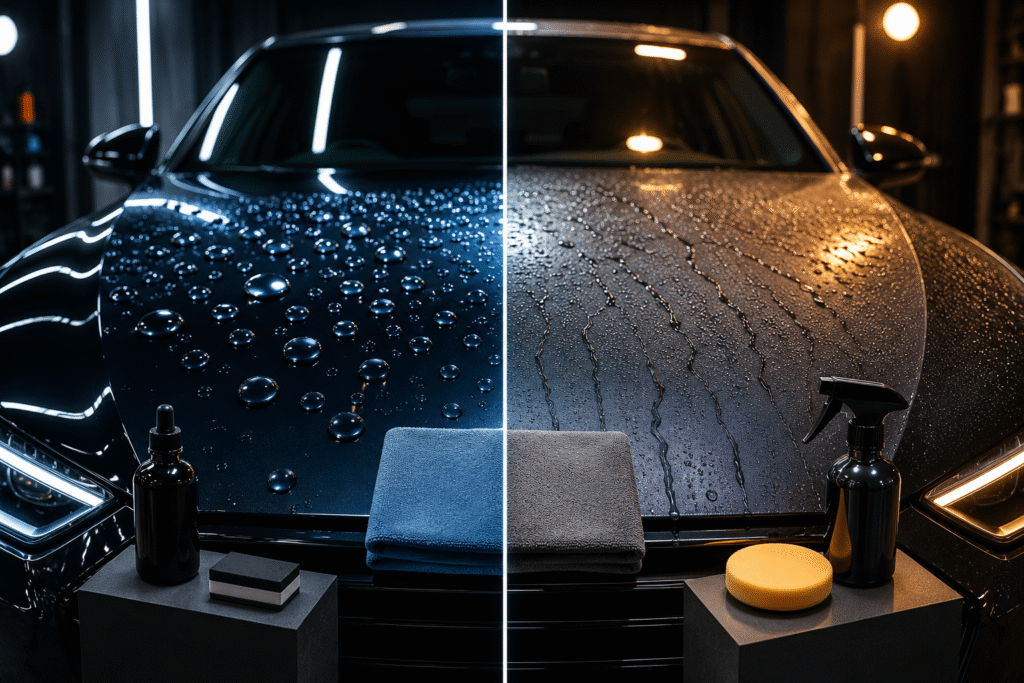
Go to any vehicle detailing business, and they’ll try to sell you both inside the first five minutes. Ceramic coating is often described as the luxury choice, whereas Teflon coating is usually sold as the budget-friendly option that still does the job. But the truth is more subtle than “expensive means better,” and selecting the incorrect one for your case means either paying too much for protection you don’t need or spending too little for protection your automobile does need.
In this blog, we break down precisely what each coating accomplishes, how long they truly last, and which one makes sense for your budget, your vehicle, and how long you expect to keep it.
What is a Ceramic Coating?
It creates a semi-permanent layer that becomes part of the surface. That’s what gives it the much-vaunted hydrophobic property. Water beads up and rolls right off instead of gathering and drying into water spots.
In addition to water beading, ceramic coating provides a true layer of protection against UV damage, oxidation, mild chemical stains from bird droppings or tree sap, and slight scratches from daily cleaning. It also gives the paint a much deeper sheen, which is why a lot of customers find their automobile appearing virtually newly painted shortly after application.
This is when the application procedure becomes tough. This means a full paint correction beforehand to remove any swirl marks, old wax residue, and any surface pollution, since the coating will lock in whatever state the paint is in at the time of application.
Advantages of Ceramic Coating
Here are some common benefits of ceramic coating:
- Long-lasting protection: Ceramic coating creates a strong protective layer on the car’s paint, which can last for many years with proper care.
- High Gloss and Shine: Enhances the look of paint by providing a smooth, glossy finish and improving color depth.
- UV and chemical protection: This coating helps protect the car paint from UV rays, oxidation, bird droppings, and other environmental impurities.
- Hydrophobic Properties: Its water-repellent surface allows water, dust, and dirt to slide off easily, making regular cleaning and maintenance easy.
Disadvantages of Ceramic Coating
Here are some common disadvantages of ceramic coating:
- Higher Initial Cost: Professional ceramic coating can be more expensive than traditional wax or sealant because of the product, preparation, and application process involved.
- Time-Consuming Application: Proper surface preparation, application, and curing can take considerable time, especially when paint correction is required.
- Not Completely Scratch-Proof: Ceramic coating can provide some resistance to minor swirl marks, but it cannot prevent deep scratches, stone chips, or damage caused by impact.
- Proper Maintenance Is Required: Regular washing with suitable products and correct cleaning techniques is necessary to maintain the coating’s performance and finish.
What is Teflon Coating?
Teflon coating is a synthetic paint protection treatment made using PTFE (polytetrafluoroethylene), a material known for its non-stick and water-resistant properties. When applied to a vehicle’s paint, it forms a thin protective layer that helps reduce minor dirt buildup, improves gloss, and offers limited protection against UV rays, oxidation, and light contaminants. Unlike ceramic coating, Teflon does not chemically bond with the paint surface, so its protective layer gradually wears off with regular washing, heat, and environmental exposure. It is a budget-friendly option for vehicle owners looking for temporary shine and basic paint protection without making a significant investment.
Advantages of Teflon Coating
Some common benefits of Teflon coating are
- Scratch and dust protection: Teflon coating creates a smooth protective layer that helps reduce the impact of dust, dirt, and fine particles on the car’s paint.
- Hydrophobic Surface: Its water-repellent property prevents water and dirt from sticking to the surface easily, making the car easier to clean.
- Improved Gloss and Shine: Teflon coating improves the look of the paint by giving a smooth, polished, and shiny finish.
- Affordable and Quick to Apply: Compared to ceramic coatings, Teflon coatings generally cost less and take less time to apply, making them ideal for short-term paint protection.
Ceramic Coating vs Teflon Coating: What’s the Difference?
Both ceramic coating and Teflon coating are designed to protect your vehicle’s paint, but they differ significantly in performance, durability, and cost. Ceramic coating forms a semi-permanent bond with the paint, providing long-lasting protection against UV rays, oxidation, chemical stains, and light scratches while delivering a deep, glossy finish. Teflon coating, on the other hand, creates a temporary protective layer that enhances shine and offers basic resistance to dirt and contaminants but wears off much faster. If you’re planning to keep your vehicle for several years and want premium protection with minimal maintenance, ceramic coating is the better investment. However, if you’re looking for an affordable, short-term solution to improve your car’s appearance, Teflon coating remains a practical choice.
Ceramic Coating vs Teflon Coating (Quick Comparison)
| Feature | Ceramic Coating | Teflon Coating |
|---|---|---|
| Protection | Advanced protection against UV rays, chemicals, oxidation & light scratches | Basic protection against dirt, dust & minor contaminants |
| Durability | 2–5 years (or more with proper maintenance) | 3–6 months |
| Paint Bonding | Chemically bonds with the paint | Forms a temporary surface layer |
| Water Repellency | Excellent hydrophobic effect | Moderate water repellency |
| Gloss Finish | Deep, long-lasting wet-look shine | Good shine that fades over time |
| Maintenance | Low maintenance | Requires frequent reapplication |
| Cost | Higher upfront investment | Budget-friendly |
| Best For | Long-term vehicle owners | Short-term protection and lower budgets |
Durability: The Best Difference
This is where the two items differ a lot, really, and is often the determining factor for most buyers:
-
- The longevity of ceramic coating normally ranges from two to five years, contingent upon the product’s quality and maintenance standards. Nevertheless, many premium professional-grade coatings, when well cared for, may exceed this duration.
-
- Teflon coating usually lasts a few months, and with proper cleaning, it may be extended to around six months, although it can visibly fade much before that if the automobile is routinely cleaned or exposed to strong sun.
-
- Having to reapply Teflon means you’re back in the store a few times a year, which adds up in expense and annoyance over time.
-
- Ceramic coating has a greater upfront cost, but the one-time expense may frequently be less per year of protection when divided over the lifetime of the coating than repeated applications of Teflon.
-
- The maintenance needs are also different. A ceramic-coated automobile still needs regular cleaning and occasional top-up sprays but nowhere near as often as a Teflon coated car needs a complete reapplication.
If you’re looking for a protection that’s not going to need continuous reapplication and you plan on keeping your automobile for many years, ceramic coating is the obvious winner. If you’re not going to keep the automobile for a long time, or you simply want something fast and cheap, Teflon still has a role to play.
Maintenance Requirements: Ceramic Coating vs Teflon Coating
The maintenance requirements of ceramic coating vs Teflon coating differ mainly based on their durability and lifespan. Ceramic coatings require regular washing with pH-neutral car shampoo and proper cleaning to maintain their shine and water-repellent properties. Teflon coating is fairly easy to maintain, but it usually requires frequent reapplication as its protective layer wears away quickly. For both types of coatings, their finish and protection can be maintained for a long time by avoiding harsh chemicals, harsh cleaners, and improper washing methods.
Which coating is right for you?
Choosing between a ceramic coating and a Teflon coating depends on your budget, expectations, and how long-term you want protection. Ceramic coating is perfect for car owners who want long-lasting protection, high shine, UV protection, and easy maintenance. On the other hand, if you want better gloss and water resistance along with paint protection at a lower cost and for a shorter period of time, Teflon coating may be a good option. Consider your driving conditions, maintenance routine, and budget before choosing the coating that best suits your car.
Gloss And Protection Level
All in all, ceramic coating offers genuinely tougher protection with better UV resistance—there’s less fading and oxidation over time—better chemical resistance, and the extra hardness provides modest resistance to fine scratches from improper washing technique. Its shine is also often deeper and more reflective, commonly called a “wet look” that may last for years, instead of fading in weeks.
Teflon coating does provide actual but not as deep protection. It makes it a little easier to keep the vehicle clean since the dirt won’t grab on quite as hard, and it does offer a transient shine, but that shine and the protection beneath it go away substantially quicker.
Price Comparisons
Ceramic coating is a much larger upfront investment, and having it done by a competent detailer of any repute isn’t cheap, particularly if you need paint correction done beforehand. However, the real cost per year of ownership usually works out to be less than paying for Teflon coating every couple of months since it lasts years, not months.
Teflon coating is more cost-effective in the short term, and for someone who only wants a little bit of improvement without a huge cost, it’s an easy sell. The numbers only favour ceramic if you anticipate maintaining the vehicle long enough to get the advantage of its multi-year lifetime. If you want to sell or trade the vehicle within a year, Teflon might really be the smarter economical decision.
Final Thoughts
No single coating is objectively “better” in all cases; it depends on how long you’re keeping the vehicle, how much you want to pay up front, and how much work you’re prepared to put into it over time. The ceramic coating benefits are long-lasting and may provide deeper protection and shine for years to come. Teflon coating is a good option for shorter-term requirements and cheaper costs, but it won’t last as long. Whatever you do, make sure the person applying it does prep the paint correctly beforehand. A hasty application defeats the greatest product on the market.
FAQs –
Yes, a little bit the dirt seems to slip off more easily directly after application and while the water beading isn’t quite as spectacular as ceramic, it is definitely better than just naked paint. That impact merely wears off quicker than people think.
Yes, but if you do, paint correction is considerably more vital beforehand.
DIY ceramic coating kits are available today and may work well enough provided you’re diligent with prep and application.
Little, but don’t expect much. It leaves a very thin protective coat that could aid a little against minor swirls while washing, but it won’t do anything substantial against a keyed panel, or severe damage from a branch or reckless parking.
Not necessary – for someone who simply needs a quick shine boost before a sale, an event, or a road trip, it performs precisely what it’s supposed to do, for less money. Only a bad decision if you anticipate a ceramic-like lifespan from it.